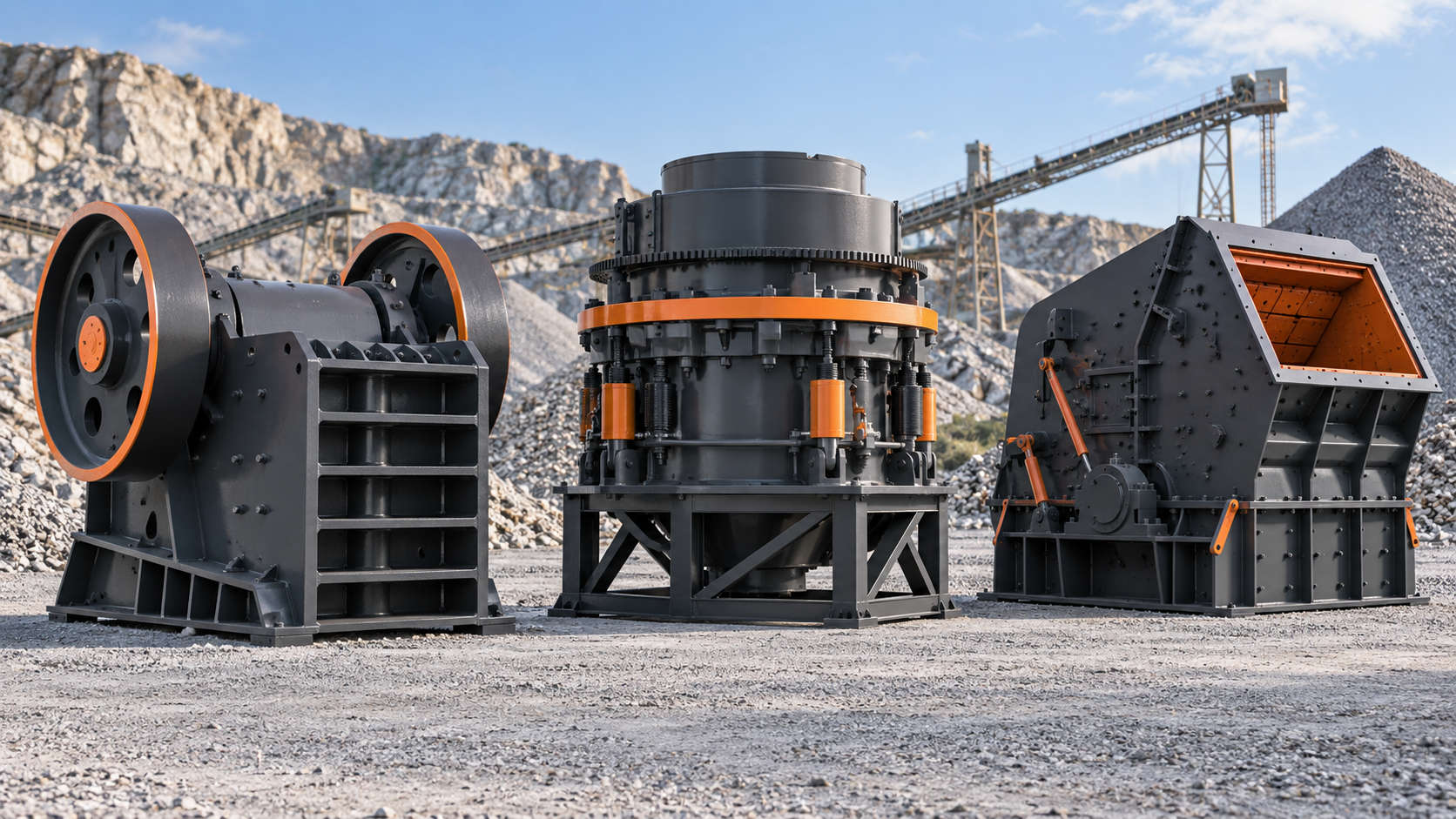
Jaw Crusher vs Cone Crusher vs Impact Crusher
- Jaw crushers commonly handle primary reduction of large feed.
- Cone crushers suit secondary and tertiary crushing of hard abrasive rock.
- Impact crushers can offer high reduction and strong particle shape.
- The correct choice depends on process stage and the whole circuit.
Jaw, cone and impact crushers use different crushing principles. None is universally best. The correct choice depends on process stage, rock properties, feed size, required reduction, product shape and acceptable wear cost.
Jaw Crusher
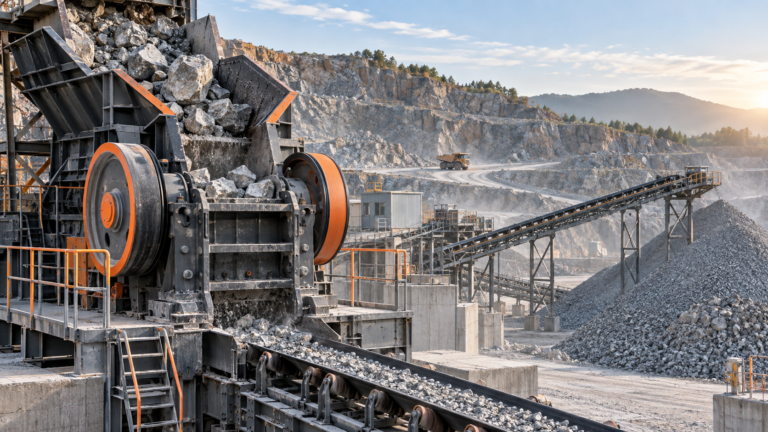
A jaw crusher compresses material between a fixed and a moving jaw. It is widely used as a primary crusher because it can accept comparatively large feed and handle varied quarry or mine material.
- Typical role: primary crushing.
- Strengths: simple crushing principle, large feed capability and robust duty.
- Considerations: product shape and reduction may require downstream crushing and screening.
Cone Crusher
A cone crusher compresses material between a moving mantle and a stationary concave. It is commonly considered for secondary and tertiary stages, especially with hard or abrasive rock.
- Typical role: secondary or tertiary crushing.
- Strengths: controlled product size, continuous crushing and suitability for hard material.
- Considerations: correct feed distribution, choke feeding and tramp protection are important.
Impact Crusher
An impact crusher accelerates material against impact surfaces. It can provide a high reduction ratio and favorable particle shape where the material and wear conditions are suitable.
- Typical role: primary or secondary crushing depending on machine type and application.
- Strengths: reduction and cubic product shape.
- Considerations: wear can increase with highly abrasive feed.
Comparison Questions
| Question | Why It Matters |
|---|---|
| What is the maximum feed size? | Determines inlet and primary crushing requirements. |
| How hard and abrasive is the rock? | Influences crushing principle and wear cost. |
| What product sizes are required? | Determines stages, closed circuit and screen duties. |
| Is particle shape critical? | May influence secondary, tertiary or shaping selection. |
| What is the required net output? | Equipment must be balanced with screens and recirculation. |
A Common Multi-Stage Approach
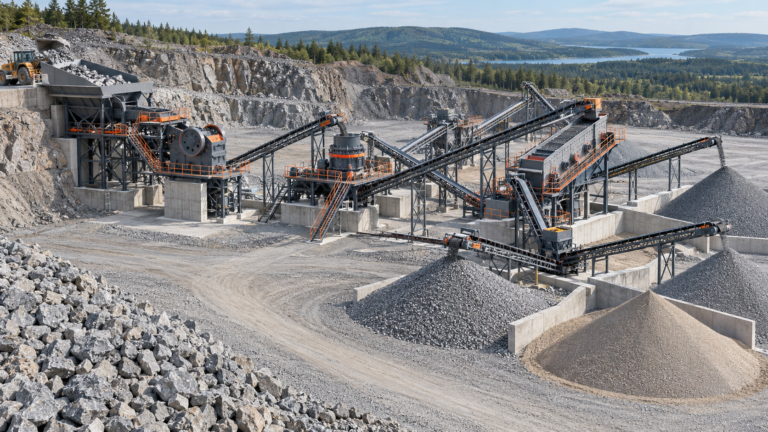
For hard quarry rock, a process may use a jaw crusher for primary size reduction and a cone crusher in a closed circuit for secondary or tertiary duty. Where shape improvement or manufactured sand is required, a separate shaping stage may be considered. Softer, less abrasive material may support an impact-based route. These are starting points, not universal rules.
Do Not Compare Crushers in Isolation
Feeders, screens, conveyors, surge capacity and return load determine whether the selected crusher can perform as intended. A process review should therefore consider the complete line, maintenance access and operating practice.
To compare options for a real project, provide the material, maximum feed size, capacity, final products and site conditions. Contact HNLANGBO for a focused equipment discussion.
Technical Decision Table
| Crusher | Typical duty | Strength |
|---|---|---|
| Jaw crusher | Primary crushing | Large feed and robust compression |
| Cone crusher | Secondary or tertiary | Hard abrasive rock in closed circuit |
| Impact crusher | Primary, secondary or shaping | High reduction and useful particle shape |
Final equipment selection should be based on confirmed material data, site conditions and the agreed technical scope.
Frequently Asked Questions
Which crusher produces the best particle shape?
Impact crushing often supports strong shaping, but abrasiveness and wear cost must be evaluated.
Can a cone crusher be the primary crusher?
Conventional cone crushers generally require controlled feed after primary reduction.
Why are screens important?
Screens determine product separation and recirculating load, directly affecting crusher duty and plant capacity.
Discuss Your Project Requirements
Send the material, feed size, target capacity, required products and site information for a practical equipment review.
Request a Project Proposal